Two Clocks
Weigh the cost of waiting against the work still needed to decide well. Recognize when another question will help—and when delay is creating its own risk.
A NEW BOOK · NOVEMBER 10, 2026
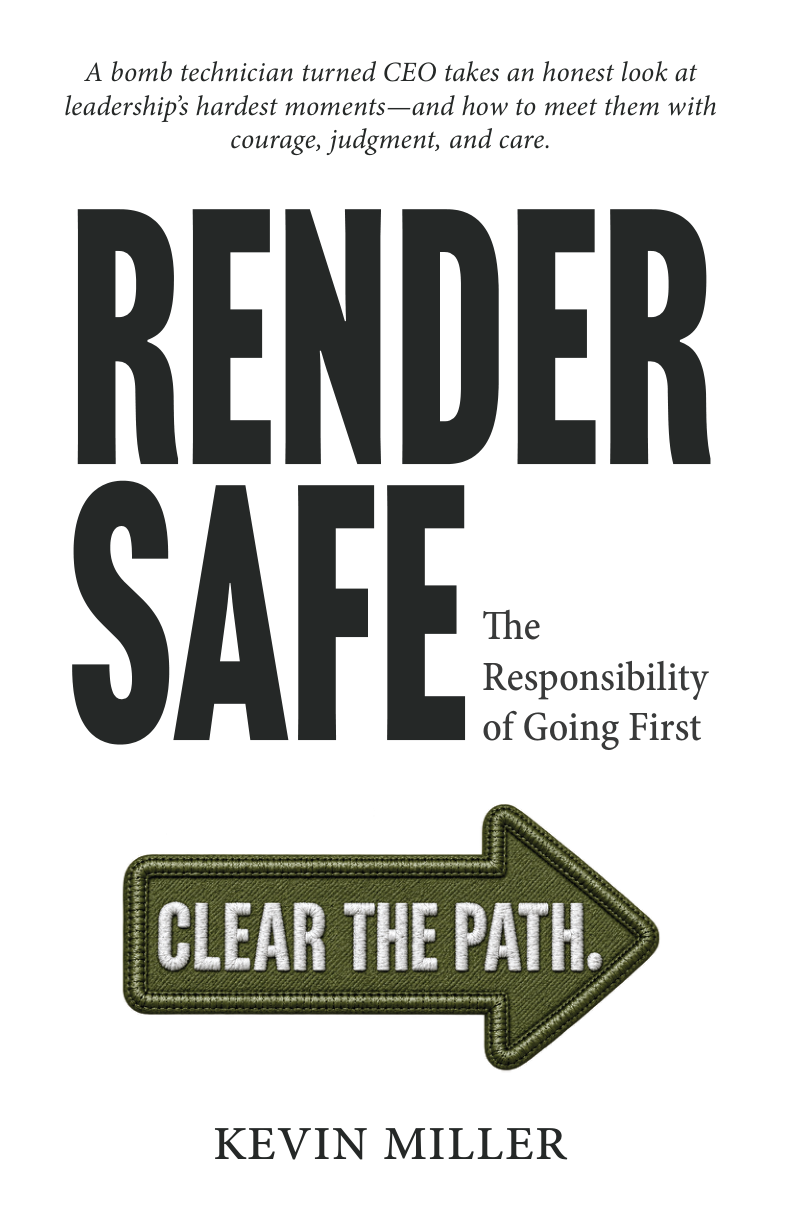
The Responsibility
of Going First
A bomb technician turned CEO takes an honest look at leadership’s hardest moments—and how to meet them with courage, judgment, and care.
FOR THE MOMENTS THAT ASK MORE OF YOU
The information is incomplete.
And you are not sure you are ready.
Kevin Miller first learned to work in that moment as an Air Force bomb disposal technician. Years later, moving from insurance underwriter to CEO, he discovered how much leadership required the same discipline—and how easily he could forget it.
Render Safe examines the decisions he got right and the failures he still carries. Stories from the field and the boardroom bring the responsibility of leadership into focus.
FROM THE PAGES OF RENDER SAFE
“The device was never the point.
The people waiting for you to clear it were.”
Kevin Miller · Render Safe, Chapter One
THREE TOOLS TO TAKE INTO YOUR WORK
Weigh the cost of waiting against the work still needed to decide well. Recognize when another question will help—and when delay is creating its own risk.
Prepare deliberately, test your reasons for hesitating, and move forward without waiting to feel fearless.
Look beyond the immediate result to the people who will live with your decision. Account for what it will require of them, even when the decision is right.
READ AN EXCERPT · CHAPTER ONE
The school’s first job was to prove I wasn’t ready.
The opening pages of Render Safe.
About a five-minute read. No signup required.
There is a moment, just before you approach an explosive device, when your brain tells your body to stop.
You feel it first in your legs. They slow without being asked. Your pulse is loud enough to hear. The edges of your vision pull in until the world is a narrow tunnel with the device at the end of it. Your mouth goes dry. Every part of you built to keep you alive is saying the same thing.
Turn around!
You do not turn around.
You slow down instead. You get low. You look at the ground, because the ground has information the briefing could not give you. Disturbed soil. A pressure plate just below the surface. A wire running toward the tree line that does not belong there. None of it is obvious from a distance. Slowing down gives you a chance to see what a hurried approach would miss.
The fear does not leave while you do this. It is not supposed to. Fear is information. It tells you to pay attention. Feeling it does not disqualify you. The work is learning to keep going when it arrives, and to help one another when it becomes overwhelming.
EOD has an axiom for this: Initial Success or Total Failure. It is not motivational language. It is a reminder of what the work can demand. You read the ground, gather the data, form your assessment, and execute with precision because a mistake can leave no opportunity for a second attempt.
That axiom changed the way I think about everything.
I was not an obvious candidate for this calling. When I left college, I knew the military was my future—it was a family tradition. But the path I chose within it was about me. It was about proving something. To the people who had made me feel unimportant throughout my childhood. To the environment that made me feel helpless at times. To myself.
I chose Explosive Ordnance Disposal because it was the hardest training program I could find, and that was the point. What I knew about EOD at the time came almost entirely from movies: a lone technician in a heavy suit, crouching over a ticking device, cutting the right wire at the last second. The hero. Unshakeable under pressure. Radiating the kind of certainty that makes everyone around them calm.
But it is nothing like that.
In the movies, bomb techs are always cowboys. They are overconfident and instinct-driven, performing bravery for the camera. They are nearly the opposite in reality: calm and deliberate, the people in the shadows, evaluating, preparing, thinking through every variable before they move. They do not radiate heroic certainty. They carry weight. The weight of the people depending on them to get it right. They know that confidence without preparation is not a virtue in this work. It is a liability.
At school, the cost of not being ready was something you woke up to.
A student would fail a practical in the afternoon. He would walk back from the range a little apart from the rest of us, carrying his own tools, and nobody would know what to say. That evening he would be in his room with the door closed. In the morning, the bunk would be stripped and the locker empty, and the class would line up for formation one person shorter.
No one made an announcement. The instructors did not need to. The empty space in the formation said everything the program wanted us to understand: the standard did not move for anyone, and it would not move for us.
These were people who had studied beside us, carried the same equipment, and wanted the qualification as badly as we did. Many had succeeded at everything they had attempted before arriving. The school was finding out whether they could use what they knew when a mistake had consequences.
The Naval School Explosive Ordnance Disposal is where EOD technicians are trained across all branches of the U.S. military. The program runs nearly a year and covers explosives theory, chemistry, physics, electronics, and the construction and render-safe procedures for an enormous range of device types.
But the technical content is not the hardest part of the program. The hardest part is what the program does to your confidence.
EOD school’s first job, it turned out, is to prove you are not ready. Not yet. Not nearly. Physically and academically, I was ready—but that was not what was being tested.
The grading made the axiom impossible to forget. Every practical exam was scored the same way. The passing grade was 85 percent. Every error—a wrong answer, a missed step, a procedure out of order—cost 16 points.
Do the math once and you understand the design. One mistake took you to 84. There was no such thing as a small error, and no way to make one up with a strong finish. A single slip was an automatic failure.
In most schools, a grade measures how much you got right. Ours measured whether you got anything wrong. The device would not give partial credit, so the school did not either.
Excerpt from Chapter One of Render Safe: The Responsibility of Going First by Kevin Miller. © 2026 Kevin Miller.
Continue the story in Render Safe.
Pre-order on KindleYou do not have to feel fearless to lead.
MEET THE AUTHOR
Bomb disposal technician.
Business leader. Author.
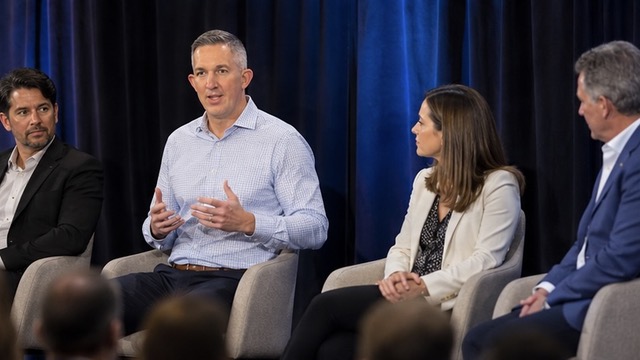
Kevin is a CEO and former U.S. Air Force Explosive Ordnance Disposal technician. Over more than twenty years in business, he rose from insurance underwriter to CEO, leading companies through turnarounds, growth, and a major acquisition.
He writes for people who have others counting on them while quietly wondering whether they are ready.
Kevin lives in Colorado with his wife and two sons.
View Kevin’s background on LinkedInKEYNOTES & LEADERSHIP CONVERSATIONS
The hard decisions rarely arrive
when everyone feels ready.
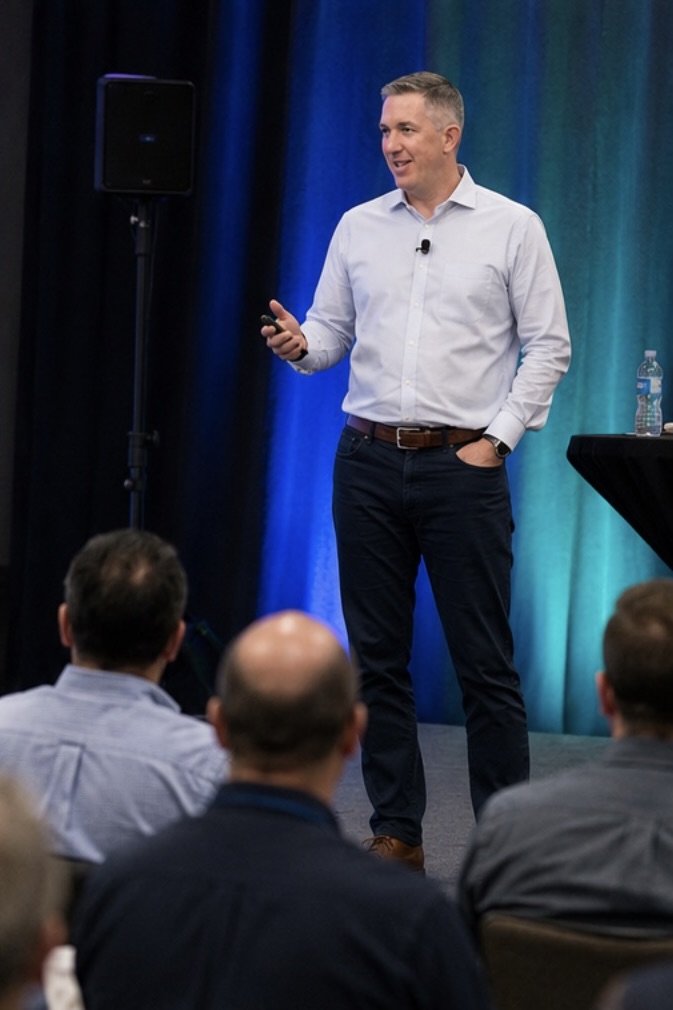
Kevin connects lessons from EOD with the realities of leading a business: incomplete information, competing demands, and people who depend on the outcome.
RENDER SAFE · KEVIN MILLER
Available November 10, 2026.
Kindle pre-orders are open now.
Kindle and paperback editions